

The Co-operative Housing Movement: A Brief History and What It Means Today
What Is a Housing Co-op?
Housing co-operatives are democratic organisations that provide homes on a not-for-profit basis. Members collectively manage their housing, with an emphasis on affordability, community, and local control. Unlike traditional tenures, such as straightforward private renting or council housing, co-ops are governed, to varying degrees, by the people who live in them. This ensures that decisions reflect the needs of residents, wherever feasible, not landlords.
The Roots of the Movement
The idea of people working together for mutual benefit has existed for centuries. Examples of co-operative practice can be found in 18th-century Greece, medieval guilds, and mutual aid societies across Europe and beyond.
The modern co-operative movement, however, is often traced to the Rochdale Equitable Pioneers, a group of working-class weavers and artisans in Lancashire. In 1844, they opened a co-operatively owned shop selling affordable food. What made them different was the development of a clear, democratic model, based on principles of shared ownership, transparency, and community control. These “Rochdale Principles” went on to shape co-operatives worldwide.
In the early 20th century, the co-partnership housing movement in Britain brought those principles into everyday housing. Residents helped shape estates, set rents, and participated in management practices still reflected in modern housing co-ops like ours
Source: Johnston Birchall, “The Hidden History of Co-operative Housing in Britain” (1991), Brunel University. This was written as part of an international project to explore co-operative housing across different countries and remains a valuable account of the UK’s co-operative housing history.
How Housing Co-ops Work Today
While co-operative housing has changed over time, the basic principle remains the same: residents play a direct role in how their homes are managed, to a greater or lesser degree depending on their type of co-op. There are many different co-op models in the UK, ranging from small self-managed groups to ones like ours that work in partnership with a local council.
At Convent Co-operative, we are what is known as a Tenant Managed Organisation (TMO) and a Residents Management Organisation (RMO). This means we manage many aspects of the estate ourselves, on behalf of Wandsworth Council, under a formal agreement. We do not own the estate – we manage it. This includes things like maintenance, cleaning contracts, communal repairs, tenancy liaison, and some aspects of estate planning. The arrangement gives residents more control than on a standard council-owned estate.
- Shareholders – Residents who choose to become members of the Co-op. Shareholders can vote at General Meetings and drive developments, such as initiating a consultancy for potential major works.
- A Management Committee – Elected shareholders who meet regularly to oversee operations, work with staff, contractors and the council, and help guide policy and planning.
This structure allows residents to remain democratic, make decisions locally, and manage their homes and estates to a high standard, reflecting the priorities of the people who live here, not external landlords. As with most things in life, there are benefits and costs to such an arrangement. For now, Convent residents have overwhelmingly decided that the benefits outweigh any perceived costs. Every five years, residents are offered an opportunity to vote on whether or not to remain a Co-op and in the 2024 ballot, 98% of those who voted chose to remain a Co-op. In addition, the decision to continue as a Co-op must be voted on each year at an AGM.
🟡 Note: Shareholding is open to most residents – council tenants, leaseholders, and freeholders. In our co-op, private tenants are not able to become shareholders at this time, but are very welcome to attend meetings and other events.
Being a shareholder helps ensure your voice is heard in how your housing is run.
What’s the Difference Between a Shareholder and a Committee Member?
Shareholders
Becoming a shareholder is the simplest and most effective way to take part. Shareholders:
- Can vote at the Annual General Meeting (AGM) and any other general meetings.
- Count toward the quorum (minimum attendance needed to make decisions official).
- Help shape the future of the co-op by voting on policies, committee elections, and other important matters.
You don’t need to join a committee once you have become a shareholder, though we always welcome ideas and questions from members. We currently have roughly a hundred shareholders.
Not a shareholder yet? We encourage you to consider signing up. It helps strengthen the co-op and ensures your voice is heard. Shares cost £1 per person. New shareholders receive a share certificate and a handbook after joining.
Committee Members
Our Management Committee is made up of up to 15 shareholders (currently 13), elected by the membership. Committee members take on a slightly bigger role in helping run the co-op. This includes:
- Attending at least six management meetings a year.
- Reading reports and reviewing documents.
- Helping make decisions about repairs, maintenance, budgeting, and in partnership with Council representatives, consider aspects of major works and cyclical decoration plans.
- Occasionally, attend training to better understand housing regulations or governance.
There are also sub-committees that deal with maintenance, staffing or finance. Sub-committees meet less often than the management committee. You can volunteer to be in one or either, or all if you’re especially keen. If you’re interested in joining a committee, please speak to us; we’re happy to explain what’s involved and answer any questions.
Why This Matters
Co-operative housing offers something different. It’s not just about having a home; it’s about having a say. Whether you’re a shareholder or on the committee, you’re part of a tradition that values fairness, democracy, and community. As is often the case with co-op’s, our leaseholder/freeholder service charges tend to be comparatively lower than the average for the borough.
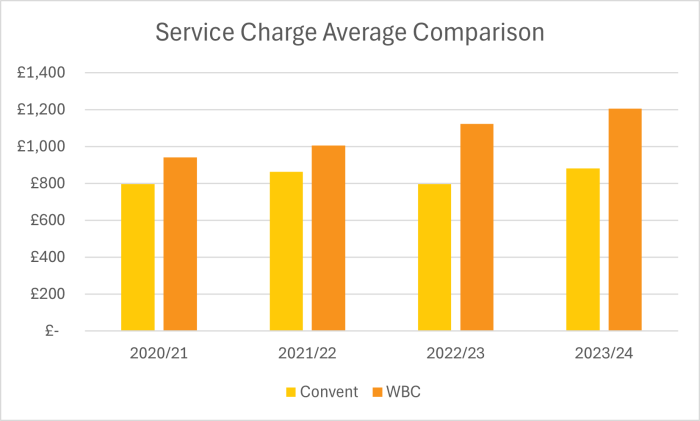
Housing co-ops everywhere are different as they are driven by the people who live and work within each organisation. There are several co-ops in the borough of Wandsworth, each with its own character. Within certain parameters set by the council, all those co-ops have a level of autonomy around how they manage themselves. Decisions might be affected by location, demographics and size. As you can see below, our co-op is relatively small, which means the Estate Manager, Lorriane, knows pretty much everyone who lives on and/or owns a property here.
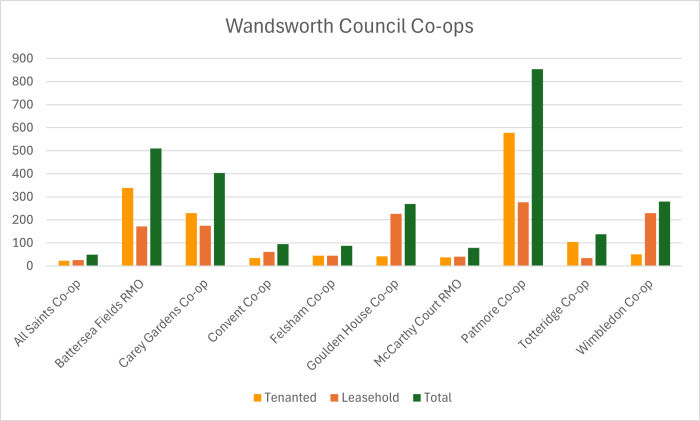
The above graph shows how Convent Co-operative, with 34 tenanted properties and 61 leaseholders, compares to other co-operatives in the borough.
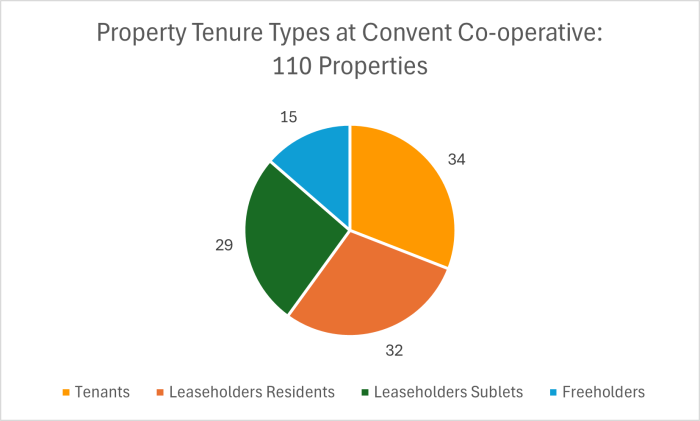
The graphic below drills down into the make up of our Co-op and also includes 15 freehold properties.
Our co-op exists to serve residents. This is your home, and your involvement, big or small, helps keep it working for everyone.
To learn more about co-operative housing in the UK, visit: